
The Greatest UFC Fighters of All Time, Ranked by Their UFC Résumés
A UFC-only top 10 weighing title-fight wins, defenses, opposition and dominance—with Jon Jones, Georges St-Pierre and Demetrious Johnson leading.
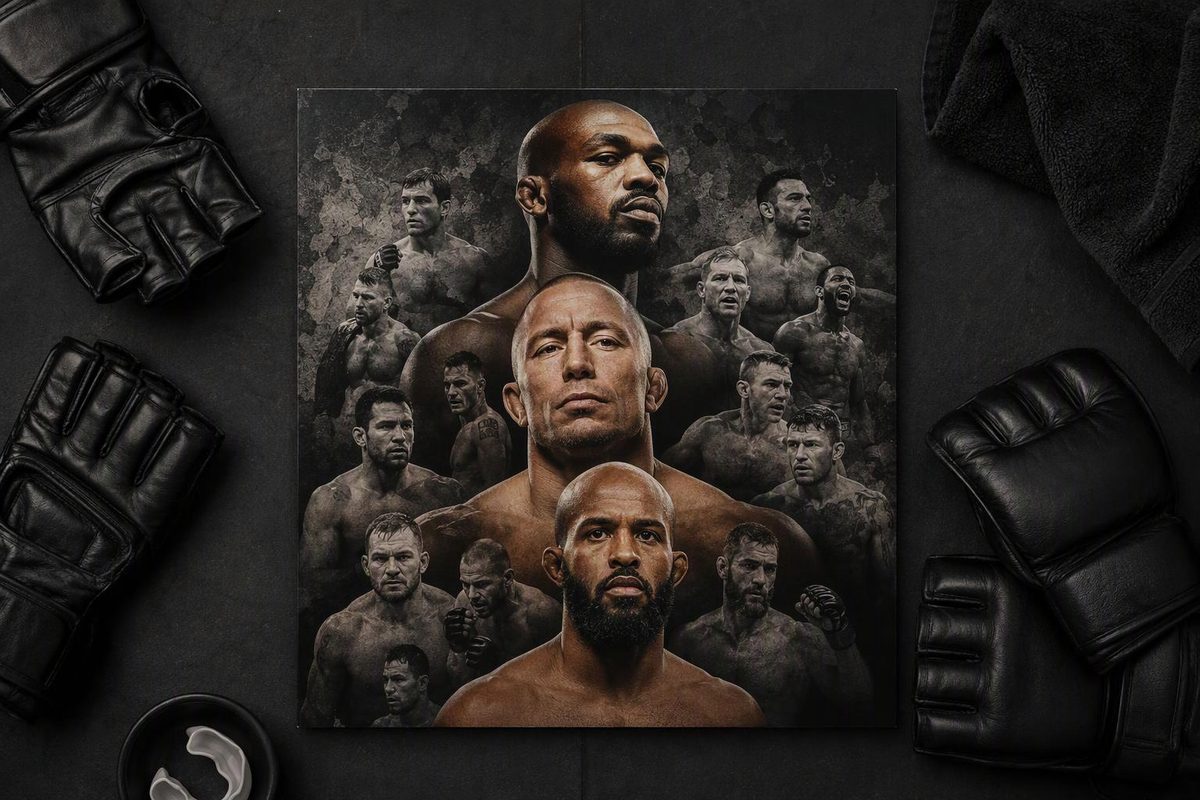
Jon Jones ranks first here for the strongest UFC championship résumé, with Georges St-Pierre second and Demetrious Johnson third. Amanda Nunes and Anderson Silva complete the top five. That is an editorial ranking—not an official UFC award or statistical proof of who was the best fighter.
Winning the most fights, producing the longest streak and repeatedly beating championship challengers are different achievements. This ranking prioritizes sustained championship success, then considers the opponents beaten, dominance within a division and success across weight classes. It does not use a weighted scoring formula or a numerical opponent-quality model.
The ranking and the numbers behind it
Scope: UFC bouts across all divisions, men and women, through October 14, 2026. Results in WEC, PRIDE, Strikeforce and ONE do not contribute to the totals. Fighters are compared relative to their divisions, not as hypothetical head-to-head opponents.
A title-fight win can capture, recapture or retain a divisional championship, including an interim title. BMF bouts are excluded. The winning defenses below require entering as champion and winning to retain the contested title. They are summed across reigns and divisions—not necessarily consecutive—and exclude draws. See our explanation of title-fight wins versus defenses.
Title-fight win totals come from the UFC Record Book, except Makhachev and Nurmagomedov, whose totals are supported by the UFC histories linked below. The Record Book starts at UFC 28; every championship victory in this table occurred after that cutoff. Defense totals are counted from the linked UFC histories and career records.
| Rank | Fighter | UFC title-fight wins | Winning UFC defenses |
|---|---|---|---|
| 1 | Jon Jones | 16 | 12 |
| 2 | Georges St-Pierre | 13 | 9 |
| 3 | Demetrious Johnson | 12 | 11 |
| 4 | Amanda Nunes | 11 | 8 |
| 5 | Anderson Silva | 11 | 10 |
| 6 | Valentina Shevchenko | 11 | 9 |
| 7 | José Aldo | 8 | 7 |
| 8 | Islam Makhachev | 7 | 5 |
| 9 | Alexander Volkanovski | 8 | 6 |
| 10 | Khabib Nurmagomedov | 4 | 3 |
The order is not simply a sort of either numerical column. Those totals establish the championship résumé; the ranking interprets it.
Why the top five lead
1. Jon Jones: the strongest championship record
Jones combines the title-fight wins lead with championship victories at light heavyweight and heavyweight. His UFC wins include Maurício Rua, Quinton Jackson, Lyoto Machida, Rashad Evans, Daniel Cormier and Glover Teixeira, followed by Ciryl Gane and Stipe Miocic at heavyweight. That breadth is the main reason he leads this ranking. His official fight history also records the Matt Hamill disqualification loss and the overturned UFC 214 result.
The anti-doping record cannot be omitted. USADA documented two sanctions, and the second Cormier bout became a no contest—not another championship win. USADA reported that the arbitrator found Jones was not intentionally cheating in that second case. This ranking counts official results rather than assigning a speculative performance penalty; readers who treat anti-doping violations as disqualifying will place him differently.
2. Georges St-Pierre: the most balanced alternative
St-Pierre finished 20–2 in the UFC, with wins over Matt Hughes, BJ Penn, Carlos Condit, Jake Shields and Michael Bisping among others. His career record combines championship volume with victories over several generations of opponents.
He avenged both career losses and made nine consecutive welterweight defenses before returning after a four-year absence to win the middleweight belt. Those achievements make him the strongest alternative to Jones here. The limitation on his two-division case: he won the middleweight championship but did not defend it. UFC’s retirement account documents that sequence.
3. Demetrious Johnson: the sustained-defense benchmark
Johnson became the inaugural UFC flyweight champion and then won 11 consecutive defenses, building an unusually long sequence of successful championship tests. His UFC wins included Joseph Benavidez, Kyoji Horiguchi and Henry Cejudo. His UFC career summary supports a top-three position without adding his later ONE achievements.
4. Amanda Nunes: championship success in two divisions
Nunes was the first woman to hold two UFC divisional titles simultaneously. More important for this ranking, she defended both and defeated Ronda Rousey, Cris Cyborg, Holly Holm, Miesha Tate and Shevchenko twice. That combination of championship breadth and named wins puts her ahead of Silva here, despite fewer defenses. Her Hall of Fame résumé details the opposition and two-division achievement.
Her eight winning defenses comprise five in her first bantamweight reign, one in her second and two at featherweight, as counted from her bout history.
5. Anderson Silva: an exceptional championship peak
Silva’s case rests on ten consecutive middleweight defenses, a 16-fight UFC winning streak and a 2,457-day title reign. His career account also records successful light heavyweight appearances, though he did not win that division’s belt.
As with Jones, anti-doping history belongs in the assessment. USADA’s Silva decision documents two violations, with the second sanction reduced after testing established supplement contamination. Those findings should neither disappear from the discussion nor be stretched into unsupported claims about every earlier fight.
The next five—and the trade-offs
6. Valentina Shevchenko: Nine winning defenses across two flyweight reigns give her a stronger longevity case than most champions. Her bout history includes championship wins over Joanna Jędrzejczyk, Jessica Andrade, Alexa Grasso, Manon Fiorot and Zhang Weili. Nunes’ two victories over her and success in two divisions favor Nunes in this comparison; head-to-head results are relevant, not sufficient by themselves.
7. José Aldo: Seven consecutive UFC featherweight defenses remain the core of his case. Keep the promotion boundary intact: his official history separates two WEC defenses from seven UFC defenses. Adding both produces nine across the organizations, not nine UFC defenses.
8. Islam Makhachev: By this cutoff, Makhachev had four lightweight defenses, a welterweight title victory and one welterweight defense. His UFC history records those seven championship wins. His victory over Ian Machado Garry also established a 17-fight UFC winning streak, surpassing Silva’s 16, as confirmed by Associated Press reporting. Cross-division success gives him the edge over Volkanovski here.
9. Alexander Volkanovski: His record includes three championship victories over Max Holloway, a non-title win over Aldo and a second featherweight reign. Those repeated wins against leading featherweights make his case stronger than title totals alone suggest.
10. Khabib Nurmagomedov: The essential number is 13–0 in the UFC, not his full-career 29–0. He finished McGregor, Poirier and Gaethje in three successful defenses. His UFC career account supports an exceptional dominance argument, but four championship wins are a smaller sample than those of the fighters above him.
What would change the order?
Weight consecutive defenses most heavily and Johnson rises. Prioritize championship wins and Jones remains first. Emphasize an unbeaten UFC peak and Nurmagomedov moves higher—but that means accepting a shorter championship sample.
This is a selected top ten, not a complete list of credible candidates. Matt Hughes’ nine title-fight wins and Stipe Miocic’s heavyweight record of three consecutive defenses offer strong alternatives, supported by the Record Book and Miocic’s UFC history.
Total wins and finishes answer different questions. For those comparisons, use our guide to the best UFC records of all time. A greatness ranking needs those records—but also an explicit choice about which achievements matter most.