
UFC Double Knockouts: What the Maynard–Emerson Finish Really Was
Maynard–Emerson ended with neither fighter able to continue, but not both knocked unconscious. Separate that no contest from double knockdowns.
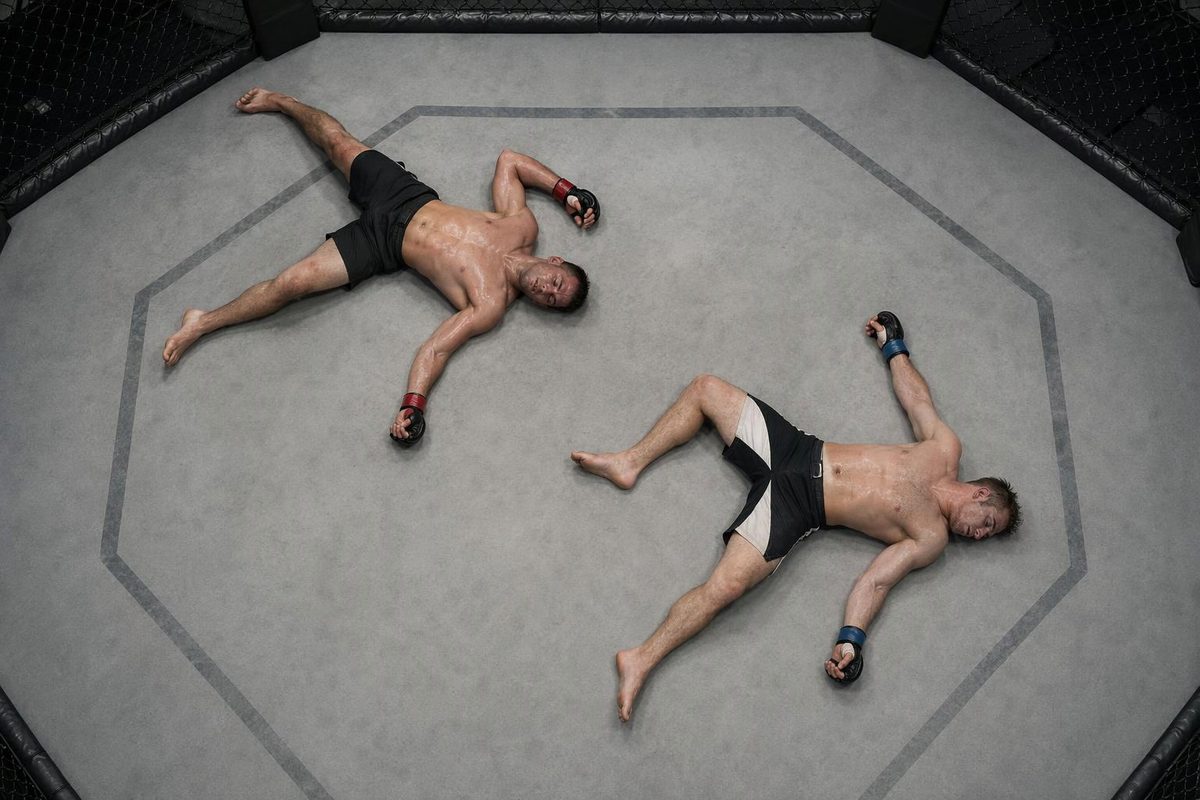
The UFC’s Maynard–Emerson no contest is often called a “double knockout,” but it was not two fighters knocking each other unconscious. At The Ultimate Fighter 5 Finale on June 23, 2007, Gray Maynard was ruled to have knocked himself out during a slam while Rob Emerson tapped because of a rib injury. The official result was a no contest, not a knockout win or a draw. UFC’s event recap explains the ruling.
That establishes a UFC fight in which neither fighter could continue—not a confirmed simultaneous, mutual knockout. The other UFC cases below do not establish that stricter claim either.
For this question, three situations need separating:
- Simultaneous double knockout: both fighters knock each other unconscious in the same exchange, ending the fight.
- Double knockdown: both fall, but recover and continue.
- Both unable to continue: the fight ends, but the causes need not be two knockouts.
Maynard vs. Emerson: a knockout ruling and an injury tap
Maynard had controlled the lightweight bout, and Emerson returned to his corner after the first round with injured ribs. Early in round two, Maynard lifted him and slammed him onto the canvas.
The landing aggravated Emerson’s ribs, prompting him to tap. But Maynard also struck his own head on the mat. The ruling was that Maynard had knocked himself out, leaving neither fighter able to continue. Maynard disputed that interpretation, saying he had believed the fight was over after Emerson tapped. Those details appear in both UFC’s recap and contemporaneous Yahoo Sports reporting.
Calling this a “double KO” obscures the important detail: Emerson tapped because of injury rather than being knocked unconscious. For a results dataset, this belongs under no contest, not KO/TKO.
Hughes vs. Newton: a disputed sequence, an official winner
Matt Hughes’ title-winning finish against Carlos Newton at UFC 34 in 2001 is another bout relevant to the question. Newton secured a triangle choke; Hughes lifted him against the fence, and Newton was knocked unconscious when he hit the canvas.
Whether Hughes had already lost consciousness is the disputed part. One UFC retrospective argues he appeared awake before the slam. Another UFC retrospective takes the opposite view, citing Hughes telling his corner, “I was out.”
The official outcome is not disputed in those accounts: Hughes won and became welterweight champion. This was not recorded as a double-knockout no contest. Even under the interpretation that both lost consciousness, the sequence involved a choke and a landing—not simultaneous knockout strikes.
Trizano vs. Choi: double knockdown, not double knockout
At UFC 281 in November 2022, Michael Trizano and Seungwoo Choi landed on each other and both fell—but both quickly returned to their feet. The contemporary report describes a double knockdown.
Trizano later won by knockout at 4:51 of round one. He explicitly distinguished the earlier exchange from a double KO in his post-fight comments: “It was just a flash knockdown.”
A genuine simultaneous double KO happened outside UFC
Tyler Bryan and Shaun Parker simultaneously landed right hooks and knocked each other out eight seconds into their fight at Legends of Fighting on May 16, 2008, in Indianapolis. MMA Junkie’s contemporary interview with referee Shonie Carter documents it.
That is a clear example of a simultaneous double knockout in MMA, but it was not a UFC bout. It should not be used as evidence of a UFC double-KO record.