
Control Measures Time; Judges Evaluate What a Fighter Does With It
Judges assess what control produces: damage, meaningful attacks, credible submission threats and sustained defensive reactions—not duration alone.
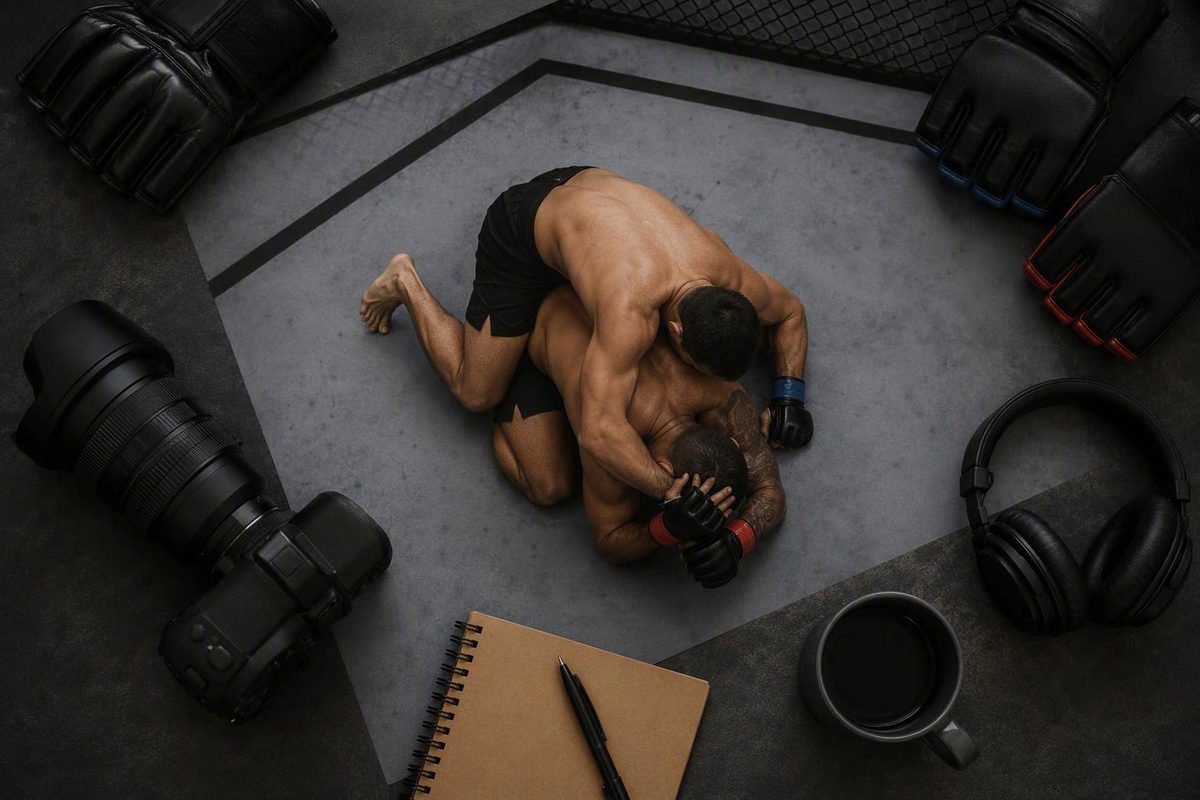
Displayed UFC control time is an elapsed-duration statistic; effective grappling evaluates the offensive consequences produced through grappling. More control time therefore does not automatically win a round. A shorter sequence can matter more when it causes damage, establishes meaningful attacks, creates a credible submission threat, or forces sustained defense.
The available judging documents do not define how UFC broadcasts or their statistical providers calculate the displayed total. It should not be assumed that the statistic includes any particular combination of top, back, clinch, or fence positions.
The short answer: control time is context, not points
Judges score each round for the more effective fighter, not automatically for the fighter with the larger control-time total. The Association of Boxing Commissions and Combative Sports’ July 2025 clarification says damage is the most highly valued component because it reflects a reduction in an opponent’s capacity or will to compete (ABC MMA Bout Scoring judging criteria clarification).
That does not make control time worthless. It provides context about the duration of a controlled exchange. What it cannot show by itself is whether the fighter caused damage, advanced into productive positions, created submission danger, forced continuous defensive reactions, or simply prevented the opponent from moving.
A box score has the same limitation. Two fighters can have very different control totals even though the shorter grappling sequence contains the round’s most consequential offense. Identical totals can also represent very different performances: one fighter may spend the time maintaining position, while another uses it to strike, advance, and threaten submissions.
A common fan debate reduces the question to “Who controlled longer?” An online discussion about control time and damage illustrates that misconception, but its fight statistics and opinions are not evidence of how a disputed round should have been scored. A sounder approach is to reconstruct the round action by action and assess what each sequence accomplished.
What judges mean by effective grappling
Effective grappling is grappling that produces meaningful offensive results. Depending on its effect, productive grappling can include:
- A takedown that causes damage or establishes an attack
- Strikes delivered from a grappling position
- A credible submission attempt
- A reversal followed by offense
- Advancement into an advantageous position that is used productively
- Sustained attacks that keep the opponent defensive
These actions do not receive equal value merely because they belong to the same category. A low-impact takedown that leads to no attack is not equivalent to a forceful takedown followed by damaging strikes. Briefly beginning a submission setup is not equivalent to securing a choke that causes visible distress or applying a joint lock that threatens damage.
A submission attempt does not need to produce a tap to matter. It can strengthen a fighter’s scoring case when it causes distress or damage, credibly threatens to end the fight, or forces the opponent into sustained defense. The relevant question is not whether the attempt was counted on a broadcast graphic, but what effect it had.
The July 2025 ABC clarification also gives immediate damage priority over cumulative damage within a round. It treats defense as unscored by itself and directs judges toward the results of effective offense. That means either the top or bottom fighter can produce the more valuable grappling: position matters, but the effective consequences of each fighter’s actions matter more (ABC judging clarification).
Position is a platform for offense, not automatic proof of dominance
There is an important distinction between achieving an advantageous position and merely maintaining it. Reaching mount, taking the back, completing a reversal, or securing top position can create a tactical advantage. The scoring case becomes stronger when the fighter uses that advantage to attack.
Consider two takedowns:
- A fighter completes a takedown, settles into guard, and spends the next minute preventing an escape without landing meaningful strikes or advancing.
- A fighter completes a takedown, lands damaging strikes, passes to mount, and attacks an arm-triangle.
Both sequences may contribute to an elapsed control total. The second has greater significance because the takedown established damaging and potentially fight-ending offense. Under the Unified Rules language reflected in the cited guidance, a takedown is assessed for the attack or impact it establishes, not merely as a change of position.
Back control illustrates the same distinction. Holding a body triangle without striking or creating a credible submission threat preserves a favorable position. Holding it while repeatedly threatening a rear-naked choke, opening opportunities for strikes, and forcing continuous hand fighting demonstrates effective offense.
Control becomes more significant when it:
- Enables damaging strikes
- Creates credible fight-ending threats
- Forces continuous defense
- Produces meaningful positional advancement
- Sustains a connected series of attacks
Successful defense can change what happens next, but it receives no independent scoring credit under the July 2025 clarification. An escape may stop an opponent’s offense and give the escaping fighter an opportunity to attack; the escape itself is not banked as offensive value. The same principle applies to blocking, surviving, or stalling without counteroffense.
Passive control versus effective grappling: a decision table
Use three questions whenever one fighter controls an exchange:
- What attack was created?
- What effect did it have?
- How close was it to causing damage or ending the fight?
| Sequence | What the statistic may show | What the judge evaluates | Likely significance |
|---|---|---|---|
| Takedown followed by static holding | Takedown and elapsed control | Impact of the takedown and whether it established offense | Limited if it produces no meaningful attack |
| Takedown followed by damaging strikes | Takedown and elapsed control | Damage and effective offense created from the takedown | Stronger scoring significance |
| Back control with no submission threat | Extended control | Whether the position produced attacks or forced meaningful defense | Position gives context, but passive maintenance adds little |
| Back control with repeated credible choke attempts | Extended control | Distress, finish potential, and sustained defensive reactions | Potentially substantial effective grappling |
| Inactive top position against damaging elbows or submissions from bottom | Top control for one fighter | Effective results produced by both fighters, regardless of position | The bottom fighter may produce the better offense |
| Reversal followed by immediate attack | Positional change and possible control | Whether the reversal directly created strikes, a submission, or another consequential attack | Productive when it establishes effective offense |
This is an interpretive checklist, not a points formula. Takedowns, reversals, submission attempts, and positional advances have no fixed numerical value. Their significance depends on what they produce and how those results compare with the opponent’s offense.
Worked example: why less control time can still win a round
Hypothetical round: Fighter A secures an early takedown and holds top position for roughly three minutes. A prevents Fighter B from standing but lands no damaging strikes, creates no credible submission threat, and makes no meaningful positional advancement. Fighter B eventually returns to the feet, lands the clearest damaging strikes of the round, and finishes with a credible submission attempt.
Action by action, the scoring picture could look like this:
- The takedown: It changes position, but its significance depends on its impact and the attack it establishes.
- The static top position: It explains Fighter A’s large control total but adds little effective offense if A creates no meaningful attack.
- Fighter B’s strikes: They may carry substantial weight if they produce the round’s clearest damage.
- Fighter B’s submission attempt: It can count as effective grappling if it creates genuine danger, distress, or a credible prospect of ending the fight.
Fighter B could win despite recording much less control time. The reason is not that control is ignored. Fighter B simply produced the more consequential offense, while Fighter A mostly accumulated elapsed positional time.
Now change what happens during the same three minutes. Suppose Fighter A’s takedown has clear impact, A lands damaging ground strikes, advances from guard to mount, and forces B to defend a credible choke. The control duration is unchanged, but the scoring case is much stronger because the position enabled damage, advancement, sustained offense, and finish danger.
These examples illustrate the judging criteria. They do not guarantee how a judge or athletic commission would score a real round, where the exact force, timing, duration, and effect of every action must be assessed.
Where duration, aggressiveness, and fighting-area control fit
Duration matters when a fighter sustains effective techniques, attacks, control, and impact—not simply because positional time accumulates. Sustained ground-and-pound or repeated submission attacks are therefore different from spending the same amount of time preventing movement without mounting offense.
The judging sequence in the applicable guidance can be expressed as a decision flow:
- Compare effective striking and grappling.
- If effective offense is equal, compare effective aggressiveness.
- If both are equal, compare fighting-area control.
Effective aggressiveness means successfully pressing toward offense, not merely moving forward or chasing an opponent. Fighting-area control means dictating the pace, place, and position of the bout. Under the Unified Rules framework, those considerations are secondary criteria rather than alternative ways to override a discernible difference in effective striking or grappling.
Forward pressure, fence position, and pace are therefore not coequal with damaging or fight-threatening offense. They may help separate an otherwise even round, but they do not automatically outweigh more effective attacks.
Passive positional control also cannot independently justify a 10-8 round under the July 2025 ABC clarification. Such a round must include significant damage or efforts or attempts capable of ending the fight; merely holding a dominant position is insufficient.
For a specific bout, the applicable rules and interpretations should be checked against those adopted by the overseeing athletic commission. Jurisdictions do not necessarily adopt every update at the same time or apply identical wording.
Can a fighter win a UFC round from bottom position?
Yes. A bottom-position fighter can win by producing the more effective offense, such as damaging elbows or credible submissions that force sustained defense, while the top fighter produces little beyond positional restraint. The July 2025 clarification assesses offense by its effect rather than awarding an automatic advantage for top position.
Does a failed submission attempt count as effective grappling?
It can. A submission attempt may matter without producing a tap if it causes distress or damage, forces sustained defense, or creates a credible fight-ending threat. A loose, momentary attempt with little effect should not be treated as equal to a deeply secured submission that places the opponent in genuine danger.
Does the UFC control-time statistic include clinch, fence, top, and back control?
The cited judging materials do not answer that question. They explain how judges assess effective grappling and related criteria, not how a UFC broadcast or statistical provider records control time. Without an official methodology for the displayed statistic, it should not be assumed that any particular combination of clinch, fence, top, or back control is included.
The practical rule for reading a scorecard is simple: treat control time as context, then examine what happened during it. Ask what offense the position created, what effect that offense had, and whether it produced damage, distress, sustained defensive reactions, meaningful advancement, or a credible finish threat. The clock records duration; effective grappling is determined by consequence.