
Wrestling vs. BJJ: Which Grappling Base Fits MMA Better?
Compare wrestling and Brazilian jiu-jitsu by goals, scoring, submissions and MMA transfer—without treating either style as a complete fight system.
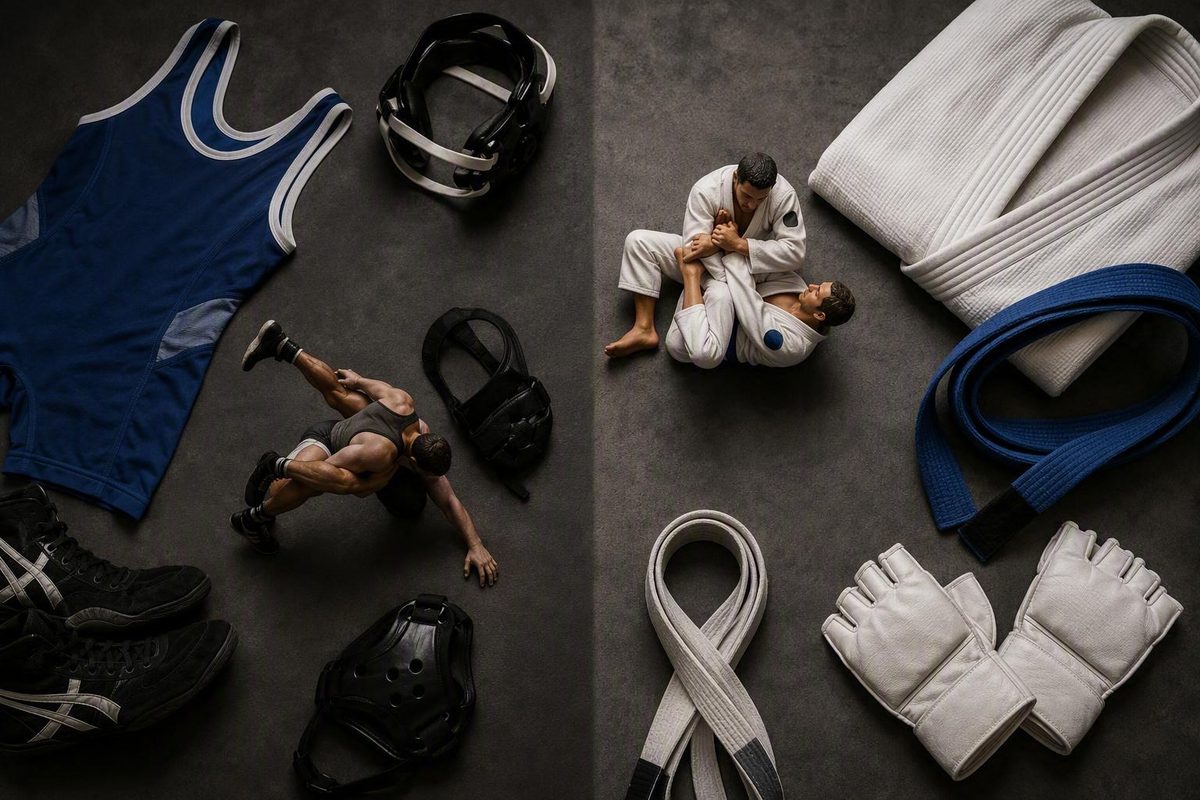
Wrestling and Brazilian jiu-jitsu solve different parts of the grappling problem. Wrestling is generally better at deciding whether and where a grounded exchange begins. BJJ is generally better at navigating the ground once it begins, especially when submissions are available.
For MMA, neither is a complete answer. The stronger base depends on the job: wrestling for takedowns, takedown defense, rides and returns; BJJ for guard work, positional escapes and submissions. An effective MMA grappler needs pieces of both, adapted for strikes and the cage.
The short comparison
| Question | Wrestling | Brazilian jiu-jitsu |
|---|---|---|
| Primary competitive goal | Pin or outscore the opponent | Submit or outscore the opponent |
| Where most training starts | Standing | Standing, but sustained ground exchanges are central |
| Signature strengths | Takedowns, balance, pressure, scrambling, top control | Guards, sweeps, positional advancement, chokes and joint locks |
| Can an athlete intentionally work from underneath? | Usually a losing or temporary state | Yes; guard is an established offensive and defensive position |
| Submissions | Not part of Olympic freestyle or Greco-Roman wrestling | A defining route to victory |
| Clothing and grips | Singlet; no jacket grips | Gi or no-gi, depending on the division |
| Clearest MMA contribution | Choosing position and keeping an opponent there | Escaping, threatening submissions and finishing on the ground |
These are tendencies, not limits on individual athletes. “Wrestling” also needs qualification: international freestyle permits attacks involving the legs, while Greco-Roman forbids grasping below the belt, trips and active use of the legs against an opponent. Both aim to win by a pin or points under United World Wrestling rules (UWW). American scholastic and collegiate folkstyle have another ruleset and place more emphasis on control and escapes.
The rules create different instincts
Wrestling rewards getting on top
A wrestler is trained to finish takedowns, resist being taken down, expose an opponent’s back and avoid being pinned. Even when a ruleset rewards turns or exposure differently, conceding bottom position is rarely a desirable long-term plan.
That produces habits with obvious MMA value: a strong stance, hand fighting, level changes, sprawls, mat returns and the ability to scramble back to the feet. It also explains why “wrestling” is not just a takedown count. The base includes the transitions before and after the recorded takedown.
BJJ keeps the match alive from top or bottom
BJJ gives the athlete underneath a developed attacking framework. Guard can be used to sweep, submit or recover position rather than merely escape. On top, the athlete can pass guard and advance to mount or back control.
The IBJJF scoreboard makes that positional ladder visible: takedowns, sweeps and knee-on-belly score two points; a guard pass scores three; mount and back control score four (IBJJF rule book). Submission is also an explicit match decision: a clear tap, verbal withdrawal or pain response can end the contest.
That ruleset develops positional patience and submission awareness. It can also create sport-specific habits—such as accepting bottom position or relying on gi grips—that need adjustment for an MMA bout.
Which is better for MMA?
The most defensible answer is wrestling is usually the better positional base, while BJJ supplies indispensable submission offense and defense. That is a division of labor, not proof that one art is universally superior.
MMA changes the value of familiar grappling positions in three ways:
- Strikes alter the risk. A guard that is productive in a grappling match may still expose the bottom fighter to legal punches and elbows.
- The fence changes movement. Takedowns, stand-ups and rides happen against a barrier rather than entirely on an open mat.
- MMA does not use wrestling or BJJ points. A takedown is not assigned an automatic two points, and passing guard is not an automatic three.
Under the Unified Rules, a referee may stand fighters up when neither is making a real, sustained effort toward a finish; merely holding an apparently superior position does not guarantee that the position will be preserved (Association of Boxing Commissions). This is also why control time should not be read as a standalone score: MMA judges assess what grappling produces, not duration alone.
A useful way to evaluate an MMA grappler is therefore not “wrestler or BJJ player?” but four narrower questions:
- Can the fighter force or deny the takedown?
- Can the fighter hold position while landing effective offense?
- Can the fighter escape bad positions and return to safety?
- Can the fighter create, recognize and defend submissions?
Wrestling tends to answer the first question and part of the second. BJJ tends to answer the third and fourth. Elite MMA grappling joins all four.
Which should a beginner choose?
Choose according to the immediate objective:
- For takedowns, balance, pace and top control: start with wrestling if a suitable adult program is available.
- For submissions and a deep recreational ground-grappling curriculum: start with BJJ.
- For MMA competition: use an MMA gym that integrates wrestling and no-gi submission grappling with wall work and strikes. Training either sport in isolation leaves rule-specific gaps.
- For gi competition: BJJ is the direct choice. Confirm the event’s division and rules rather than assuming every submission is legal; IBJJF maintains a current rule-book download and separate rules updates (IBJJF).
The cleanest conclusion is not that wrestling beats BJJ or vice versa. Wrestling offers stronger control over the location of a fight; BJJ offers a broader submission game and a more developed system for operating from underneath. In MMA, the better skill is whichever closes the fighter’s current gap—and the better overall grappler can wrestle into favorable positions without becoming lost when the exchange turns into jiu-jitsu.